

Choosing the right HYROX division is one of the first decisions an athlete makes before registering for a race. While every division is built around the same core HYROX format, the way athletes compete, share the workload, and handle prescribed weights changes depending on the category.
The four main HYROX race formats are Open, Pro, Doubles, and Relay. Open and Pro are designed for individual athletes, Doubles allows two athletes to race together, and Relay divides the race among a team of four.
Understanding those differences makes it much easier to choose a division that matches your current fitness level, competitive goals, and preferred racing experience.

HYROX Open
HYROX Open is the standard individual division and the most straightforward option for athletes who want to complete the entire race themselves.
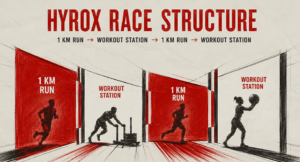
An Open athlete completes all eight 1 km runs and all eight workout stations individually. The total running distance is therefore 8 km, with a workout station following each 1 km segment.
Open is divided into:
- HYROX Women
- HYROX Men
The important distinction is that “Open” does not mean a shortened version of HYROX. Athletes still complete the complete race format. Instead, Open uses the standard prescribed weights for the workout stations.
For example, according to the HYROX race standards, the Open divisions use different loads for movements such as the sled push, sled pull, farmers carry, sandbag lunges, and wall balls.
HYROX Open is generally the most logical division for someone who wants the full individual HYROX experience without moving into the heavier loads prescribed in Pro.

HYROX Pro
HYROX Pro follows the same fundamental individual race structure as Open: eight 1 km runs combined with eight workout stations.
The primary difference is the heavier prescribed weights used at several stations. HYROX describes Pro as the category for experienced racers looking for a more challenging version of the race.
The individual Pro divisions are:
- HYROX Women Pro
- HYROX Men Pro
The difference becomes clear when comparing some of the prescribed loads.
For the sled push, for example, Women Open uses 102 kg including the sled, while Women Pro uses 152 kg. Men Open uses 152 kg, while Men Pro increases to 202 kg.
The same progression appears in other stations. Farmers carry weights increase from 2 x 16 kg to 2 x 24 kg between Women Open and Women Pro, and from 2 x 24 kg to 2 x 32 kg between Men Open and Men Pro. Wall balls increase from 4 kg to 6 kg for women and from 6 kg to 9 kg for men.
Pro therefore isn’t simply about trying to finish faster. Athletes must manage the same running volume while handling significantly greater resistance during key strength-based stations.
For athletes deciding between Open and Pro, the ability to perform those heavier race-specific loads efficiently while fatigued is an important consideration.

HYROX Doubles
HYROX Doubles changes the race experience by allowing two athletes to compete as a team.
The partners run the 1 km segments together, but they can divide the work at the workout stations between themselves.
The primary Doubles categories include:
- HYROX Doubles Women
- HYROX Doubles Men
- HYROX Doubles Mixed
Pro Doubles categories are also offered at HYROX events, including Women Pro Doubles and Men Pro Doubles.
The key element in Doubles is that athletes cannot simply divide the entire race in half. Both partners still have to complete the running portions together.
What they can share is the workload inside each station.
That creates a different competitive dynamic from Singles. Teams need to decide when each athlete should work, how frequently to switch, and how to distribute repetitions or distance without wasting time during transitions.
Doubles can therefore suit athletes who want to experience the full HYROX course with a partner while sharing the station workload.

HYROX Mixed Doubles
Mixed Doubles follows the same partner-based structure but pairs male and female athletes in the same team.
One detail is particularly important when choosing this division: Mixed Doubles uses the men’s Open prescribed weights for both athletes at applicable weighted stations.
For example, both Mixed Doubles athletes use a 20 kg sandbag for lunges and a 6 kg wall ball.
This is worth considering when planning how the team will divide its workload, particularly at stations where strength differences between partners could influence race strategy.

HYROX Relay
HYROX Relay divides the race among four athletes.
Instead of every athlete completing the entire HYROX race, each team member is responsible for two 1 km runs and two corresponding workout stations.
HYROX Relay includes:
- Women’s Relay
- Men’s Relay
- Mixed Relay
This makes Relay fundamentally different from Doubles.
In Doubles, both partners run throughout the race and share the station work. In Relay, the overall race is divided among four athletes, significantly reducing the amount of running and station work completed by each individual.
Relay can be especially useful for groups that want to compete together or athletes who want exposure to HYROX competition without individually completing all eight runs and eight stations.
Open vs. Pro vs. Doubles vs. Relay
The simplest way to understand the HYROX divisions is by looking at who completes the race and how the workload is distributed.
| Division | Athletes | Running | Workout Stations | Main Difference |
| Open | 1 | All 8 x 1 km runs | All 8 stations | Standard individual race |
| Pro | 1 | All 8 x 1 km runs | All 8 stations | Heavier prescribed weights |
| Doubles | 2 | Both athletes run together | Workout can be shared | Partner-based racing |
| Relay | 4 | 2 x 1 km per athlete | 2 stations per athlete | Race divided among four athletes |
The race format itself remains recognizable across every division. What changes is the individual workload and, in Pro, the prescribed resistance.

HYROX Age Groups
Race division and age group are not necessarily the same thing.
HYROX uses age groups within its divisions to classify athletes and produce rankings. Current age-group classifications begin with 16–24, followed by 25–29, 30–34, 35–39, and subsequent five-year brackets.
This means two athletes can both compete in HYROX Open, for example, while being ranked within different age groups.
For athletes interested in competitive placement rather than simply completing the race, understanding both the division and age-group classification is important when reviewing results.

Which HYROX Division Should You Choose?
The right division depends primarily on how you want to experience the race.
Choose Open if you want to complete the full HYROX race individually using the standard prescribed weights.
Choose Pro if you’re an experienced HYROX athlete and want to race individually with the heavier Pro loads.
Choose Doubles if you want to race alongside a partner, complete every run together, and share the workout stations.
Choose Relay if you want to compete as part of a four-person team and divide the complete HYROX race among the group.
There is no need to choose a harder division simply because you’re becoming fitter. The better question is which format matches the type of race you want to compete in and the performance you’re training to achieve.
Training for Your HYROX Division in Miami
Whichever division you choose, training should reflect its specific demands. An Open athlete needs to prepare to complete every station independently, a Pro athlete needs sufficient capacity for the heavier prescribed loads, Doubles partners need to practice workload distribution, and Relay athletes need to prepare for the specific running and station demands they may handle on race day.
For athletes looking for HYROX training in Miami, A´CLUB opens its doors in November 2026 to HYROX athletes and enthusiasts at 1750 North Bayshore Drive, Miami, Florida 33132.
Located in Miami, A´CLUB is built around hybrid training and offers HYROX-focused training alongside strength, conditioning, running, and mobility work.
Whether the goal is a first HYROX Open, a move into Pro, competing with a Doubles partner, or preparing for a Relay team, understanding the requirements of the chosen division is the first step toward training specifically for race day.