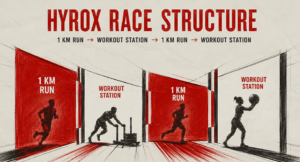


One of the reasons HYROX has become such a recognizable fitness competition is the consistency of its race format. No matter where you compete, the fundamental challenge remains the same: eight 1 km runs combined with eight functional workout stations, completed in a fixed order.
That means every athlete covers a total of 8 km of running while working through eight different stations that test endurance, strength, efficiency, and the ability to keep moving under fatigue.
The structure is simple to understand. Executing it well is a different challenge.
As Alexis Bernier, co-founder of A´CLUB and HYROX Elite 15 athlete, often emphasizes in his approach to hybrid training, HYROX is not simply about being a strong runner or being good at individual exercises. The challenge comes from repeatedly moving between the two.
Understanding exactly how the race unfolds is therefore one of the best places to start.

The HYROX Race Structure
Every standard HYROX race follows the same basic sequence:
1 km Run → Workout Station → 1 km Run → Workout Station
This pattern continues until the athlete has completed all eight runs and all eight workout stations.
The complete race is:
- 1 km Run
- 1,000 m SkiErg
- 1 km Run
- 50 m Sled Push
- 1 km Run
- 50 m Sled Pull
- 1 km Run
- 80 m Burpee Broad Jumps
- 1 km Run
- 1,000 m Row
- 1 km Run
- 200 m Farmers Carry
- 1 km Run
- 100 m Sandbag Lunges
- 1 km Run
- 100 Wall Balls
The order matters. Athletes must complete the runs and workout stations sequentially to receive a valid finishing time.
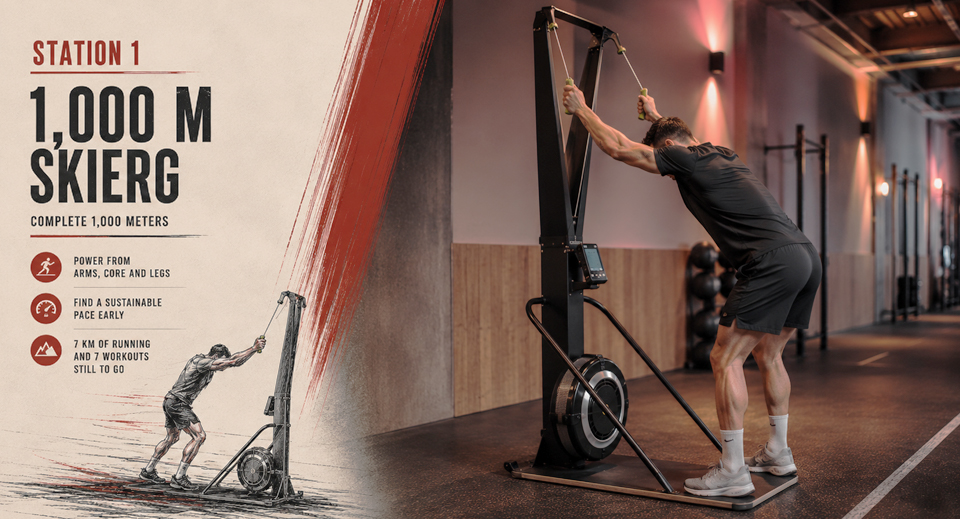
Station 1: 1,000 m SkiErg
After the first kilometer of running, athletes enter their first workout station: the SkiErg.
The goal is straightforward: complete 1,000 meters.
Because it comes early in the race, this station can feel relatively controlled. That can make it tempting to push the pace immediately, but the athlete still has seven kilometers of running and seven workout stations ahead.
The SkiErg introduces one of the central challenges of HYROX: deciding how much energy to use now without compromising the work that follows.
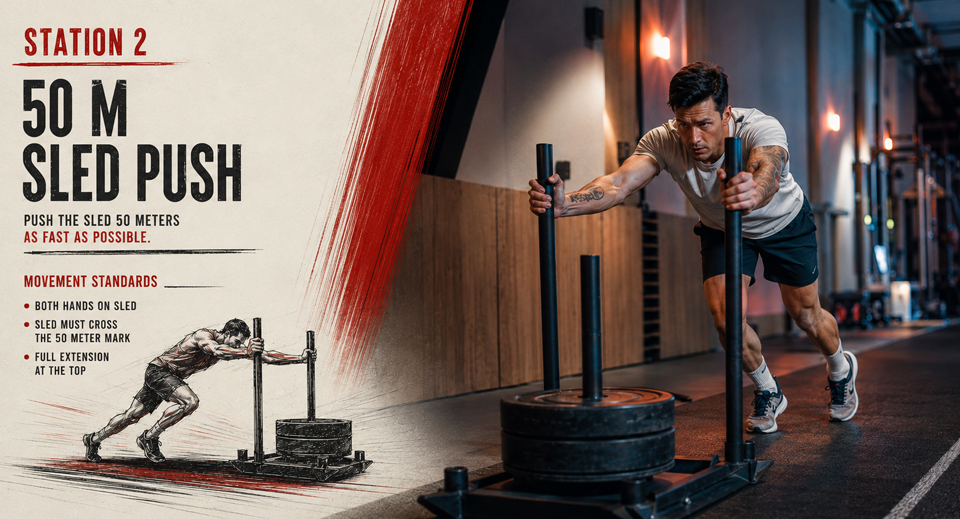
Station 2: 50 m Sled Push
Following the second 1 km run comes the Sled Push.
Athletes must push the prescribed sled for a total distance of 50 meters. The required load depends on the race division.
Unlike the SkiErg, the sled can place significant demand on the legs. That matters because athletes return directly to running once the station is complete.
The challenge is not simply moving a heavy sled. It is moving it efficiently and then being able to transition back into a sustainable running pace.

Station 3: 50 m Sled Pull
After another kilometer of running, athletes return to the sled area for the Sled Pull.
The objective is again to cover 50 meters, this time by pulling the sled using a rope.
Grip, upper-body strength, lower-body positioning, and efficient movement all become important here. Just as with the Sled Push, the prescribed weight varies by division.
By the end of this station, athletes have completed three workout stations and three kilometers of running.
There is still a significant amount of racing ahead.

Station 4: 80 m Burpee Broad Jumps
The fourth workout station is 80 meters of Burpee Broad Jumps.
Athletes move forward through repeated burpees followed by broad jumps until the full distance is completed according to HYROX movement standards.
There is no machine or sled to control the pace for you here. Each repetition requires the athlete to move their own body through the prescribed movement while continuing to progress forward.
Coming after four kilometers of accumulated running, this is also where maintaining efficient movement becomes increasingly important.
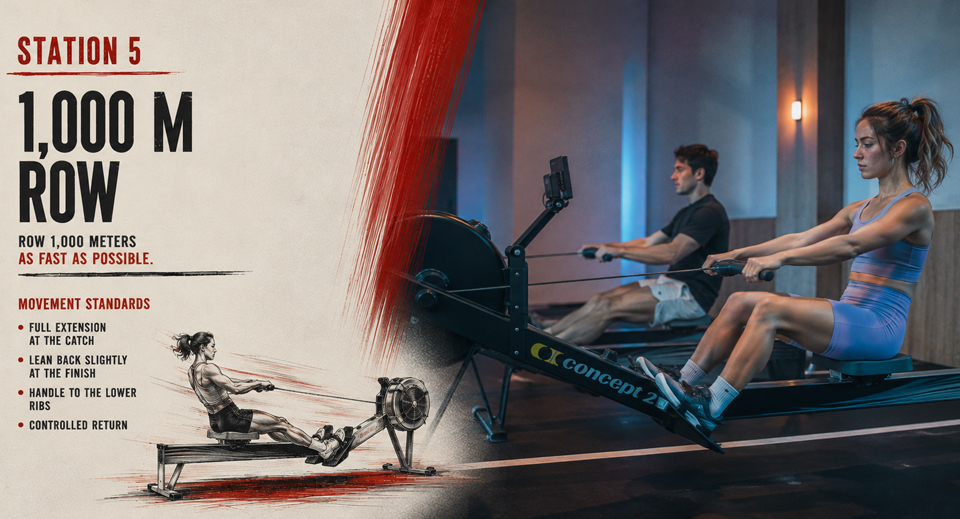
Station 5: 1,000 m Row
After the fifth 1 km run, athletes complete 1,000 meters on the rowing machine.
The Row begins the second half of the workout stations.
Like the SkiErg, it rewards controlled output. An athlete can increase the intensity and finish the distance faster, but doing so also increases the energy cost before the final three runs and stations.
At this stage of the race, pacing decisions made earlier often become much more noticeable.

Station 6: 200 m Farmers Carry
After kilometer six comes the 200 m Farmers Carry.
Athletes carry two kettlebells through the designated course, with the prescribed weight determined by their division.
The movement places significant demand on grip strength and the ability to maintain posture while carrying load.
Although 200 meters may sound relatively short, it arrives after six kilometers of running and five previous workout stations. The cumulative fatigue is part of what makes the HYROX format different from performing these movements independently in training.

Station 7: 100 m Sandbag Lunges
Following the seventh kilometer, athletes complete 100 meters of Sandbag Lunges.
The sandbag remains with the athlete while they perform walking lunges through the designated distance.
At this point, the legs have already accumulated substantial work from running, pushing, pulling, jumping, rowing, and carrying.
That makes the lunges less about isolated leg strength and more about the ability to continue producing controlled movement late in the race.
Once the 100 meters are complete, only one run and one workout station remain.

Station 8: 100 Wall Balls
Athletes complete their eighth and final 1 km run before entering the last workout station: 100 Wall Balls.
The athlete must perform the prescribed squat-and-throw movement using the appropriate wall-ball weight and target according to their division.
It is a simple movement on paper.
After 8 km of running and seven previous stations, however, maintaining consistent repetitions becomes considerably more demanding.
The finish line comes after the required 100 repetitions have been successfully completed.

Why the Running Changes the Entire Race
Looking only at the eight workout stations can give an incomplete picture of HYROX.
The running is not a separate portion of the competition. It connects every station.
Athletes repeatedly have to transition from running into functional work and then return to running with accumulated muscular fatigue.
The kilometer after the Sled Push will not necessarily feel like the kilometer before it. Running after Burpee Broad Jumps presents a different challenge from running after the Row or Farmers Carry.
This is one of the most important characteristics of the format.
From my perspective as both a coach and competitor, HYROX rewards athletes who can manage the entire race rather than treating each station as an isolated test. Strength matters. Running matters. But so do pacing, transitions, movement efficiency, and the ability to maintain output as fatigue builds.
That combination is what makes the format so interesting to race and to train for.
— Alexis Bernier, Co-Founder of A´CLUB & HYROX Elite 15 Athlete
The ROXZONE and Transitions
Race time is not determined only by running and workout performance.
Athletes also move through the ROXZONE, the transition area connecting the running course with the workout stations.
These transitions are part of the race.
Time continues to move while an athlete enters the station area, reaches the appropriate equipment, completes the workout, exits, and returns to the running course.
That means two athletes with similar running and station performances can still produce different finishing times depending on how efficiently they move through transitions.
HYROX uses timing chips to record performance, and athletes receive an official finishing time along with split information that allows different portions of the race to be analyzed afterward.

What Makes the HYROX Format Different
HYROX does not ask athletes to perform one continuous endurance discipline, nor does it test strength through isolated maximal efforts.
Instead, it repeatedly changes the physical demand.
You run.
You work.
You run again.
And you repeat that process eight times.
The movements themselves are relatively easy to understand. The difficulty comes from performing them in sequence while fatigue continues to accumulate.
That predictable structure is also what makes HYROX measurable. Athletes know what is coming and can prepare specifically for the demands of each section of the race.
For athletes and HYROX enthusiasts in Miami who want to train specifically for this type of challenge, A´CLUB will open its doors in November 2026 at 1750 North Bayshore Drive in Miami, bringing its hybrid training approach to the local community.
The goal is not simply to practice individual HYROX movements. It is to prepare athletes to handle the way those movements actually appear on race day: between kilometers, under fatigue, and as part of one continuous race.